

Imperial Threads: Trade Protectionism and the Direction of Innovation
Abstract
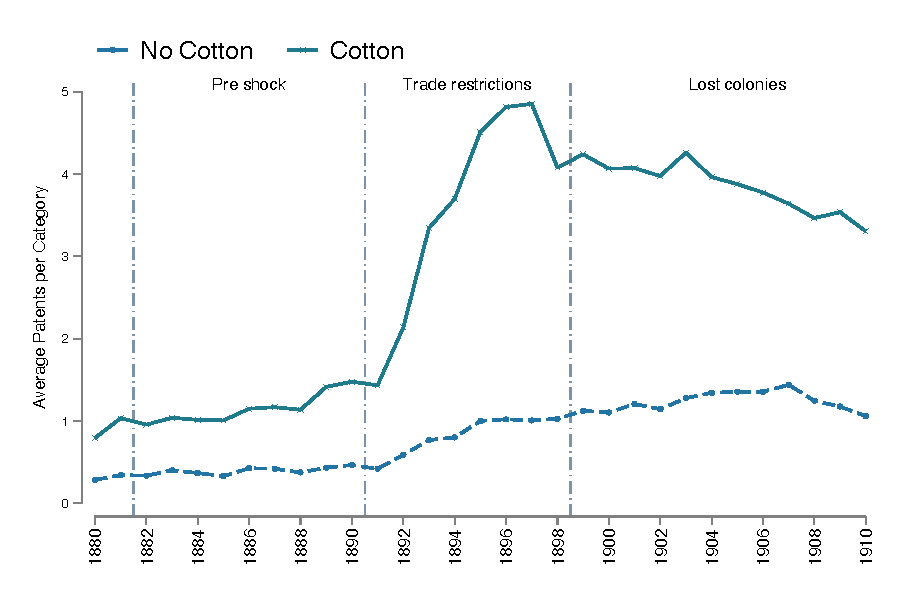
Captive colonial markets shape innovation in ways that outlast the markets themselves. Spain’s colonial system created a captive market for cotton textiles through two complementary reforms: a 1882 bilateral preference agreement and a 1891 increase in domestic protection. Neither reform alone was sufficient to redirect inventive activity toward cotton. Exploiting variation across different textile fibers, I find that cotton patenting rose by 13.5 patents per category relative to other fibers at the peak of colonial access, driven by domestic inventors rather than the adoption of foreign technology and accompanied by a significant expansion of mechanized looms. A significant share of the innovation response occurred after Spain lost its colonies in 1898, consistent with path dependence through knowledge spillovers rather than persistent protection. A directed-technical-change model formalizes the complementarity between the two reforms and shows that the composition of colonial demand, rather than domestic market size alone, is what redirected innovation. These findings establish that the structure of captive markets can permanently shift an economy’s technological trajectory.